
Hey, mamas!
Some days of mothering and keeping the household running leave us breathlessly tired. Our minds are wracked by to-do lists that never seem to end.
It’s no secret being a mom can be busy– but have you ever thought of the mental load of motherhood as a contributing factor? How does managing household products and making decisions contribute to this load? Can we alleviate and simplify some of this?
Listen to my thoughts about it all in this relateable podcast episode on my show, A (Mostly) Stay-at-Home-Mom:
This post contains affiliate links. I may earn a small commission at no cost to you. As an Amazon Associate, I earn from qualifying purchases.
We Have a Mental Load Problem Because We Have a Stuff Problem
When we analyze modern American households, the statistics are staggering. Since the 1960s, our average home size has increased by almost 1,000 square feet (from 1,500 to 2,300 square feet) while our family sizes have simultaneously shrunk. Even more telling, one in five Americans rents a storage unit – that’s 23 million units nationwide! We’ve created homes larger than ever before, yet still can’t contain all our possessions. This paradox reveals something profound about our relationship with material goods.
The management of household products creates an often overwhelming mental burden for mothers.
Every item that enters our home requires decision-making, space consideration, cleaning, organization, and eventual disposal.
The sheer volume of products we manage daily – from groceries to cleaning supplies, children’s toys to clothing, digital subscriptions to kitchen gadgets – creates a constant background hum of responsibility.
This invisible work doesn’t produce tangible results, yet it consumes significant portions of our time, attention, and emotional energy.
Why Our Homes Have Become Buried in Stuff
I’ve identified two major factors driving this product overload.
First, acquisition has never been easier. From Amazon deliveries to drive-through pickups, consumer goods are more accessible and affordable than ever. While our grandmothers might have saved for months to purchase a new dress, we can order several with a single click. This ease of acquisition, combined with our culture’s emphasis on consumption, creates a continuous cycle of stuff entering our homes.
The second factor is equally powerful: our emotional attachment to possessions. Items carry nostalgia, memories, hopes, and aspirations. That exercise equipment represents our fitness goals; craft supplies embody creative ambitions; children’s toys hold precious memories. This emotional connection makes decluttering far more challenging than we expect.
How to Select Meaningful Products for the Home
When facing this overwhelming tide of stuff, I’ve found that developing a personal decision-making framework helps tremendously.
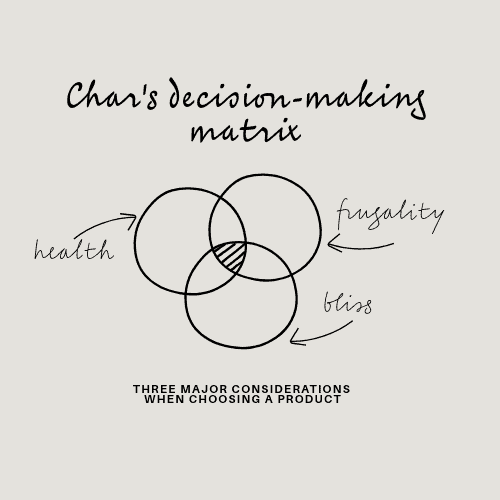
My decision matrix weighs three primary considerations for any product entering our home: health/sustainability, affordability/frugality, and enjoyment/fun.
These factors compete constantly, requiring thoughtful balance.
Sometimes health takes precedence, other times budget constraints win out, and occasionally, pure enjoyment carries the day (like my husband’s beloved tater tots!). This framework doesn’t provide perfect solutions, but it does create intentionality around what I allow into our living space.
Finding Baby and Kids Products That Are Actually Worth It
As parents, this product management challenge intensifies dramatically. The baby industry bombards new parents with “essential” products, many of which prove unnecessary or impractical.
(Like a special trash can for diapers? Not falling for that one– I’ll use a regular trash can, thank you!)
Through experience with my two children, I’ve learned which items truly serve our family and which create more work than benefit. Multi-purpose items like mason jars (which we use for food storage, canning, and with silicone tops as toddler cups) have become my gold standard – versatile, durable, and space-efficient.
There are even more multi-purpose children’s items if you think creatively.
What about purchasing good-quality organic cotton T-shirts that can be worn by both boys and girls? That’s just one idea.
My ultimate list of the most worthwhile baby and kids products can be found in this blog post, if that helps ease some of your decision making. These are our tried-and-true staples!
How to Navigate the Muddy Waters of Household Products and Decision Making
The path toward a more manageable home environment begins with awareness of these challenges. By recognizing the mental load associated with product management, we can approach consumption more intentionally. Simple practices like regular decluttering, thoughtful purchasing, and establishing systems that work for your specific family can dramatically reduce this invisible burden. Remember, the goal isn’t perfection but creating a home environment that supports your family’s wellbeing rather than depleting your mental resources.
Most importantly, give yourself grace in this process. The overwhelming nature of product management in modern homes isn’t a personal failure – it’s a systemic challenge we all face. By acknowledging this invisible work and developing strategies to manage it effectively, we can reclaim some of our precious mental bandwidth for what truly matters: being present with those we love.
That’s it for this week’s (Mostly) Stay-at-Home-Mom. For more episodes, you can find the show on Apple Podcasts and Spotify. You can also dig into more of my motherhood articles here on By Charmaine’s blog. Thanks for listening!